

Am I ready to buy a home? Why so many first-time buyers think the answer is no.

There’s one question that many prospective homebuyers ask themselves long before they ever speak with a loan officer:
Am I ready to buy a home?
It’s a reasonable question. Purchasing a home is one of the most significant financial decisions a person will make, and there’s no universal checklist that tells someone exactly when the timing is right. Some people worry they haven’t saved enough for a down payment. Others question whether their credit score is high enough or whether they earn enough to qualify for a mortgage. Many simply wonder whether they’re overlooking something important that everyone else seems to understand.
These concerns are understandable. However, they also reveal something the housing industry has traditionally overlooked. Conversations about first-time homeownership often focus on affordability, mortgage rates, housing inventory and down payment requirements. Those factors undoubtedly influence purchasing decisions, but they don’t fully explain why so many prospective buyers delay taking the first step.
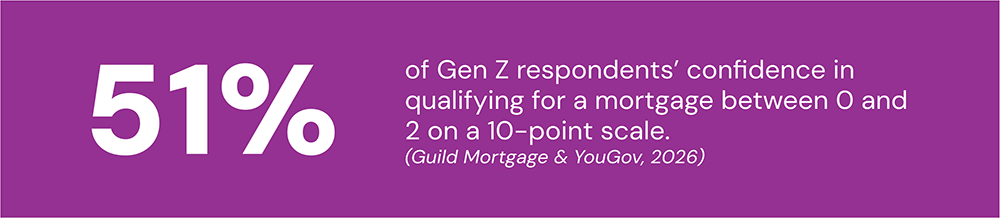
Recent national research conducted by Guild Mortgage and YouGov points to another barrier that deserves equal attention: confidence. Among Gen Z adults who reported actively considering purchasing a home, 51 percent rated their confidence in qualifying for a mortgage between 0 and 2 on a 10-point scale (Guild Mortgage & YouGov, 2026).
Being ready is about more than your bank account
One of the most common misconceptions about homeownership is that there’s a single financial milestone that determines whether someone is ready to buy a home. While income, credit history and savings are certainly important, they represent only part of the picture.
Readiness is better understood as the intersection of financial preparation, personal goals and knowledge. A prospective buyer with stable employment, responsible financial habits and a clear understanding of the responsibilities of homeownership may be better positioned than someone who simply reaches a particular income level but has never explored the mortgage process.
Equally important is recognizing that every homebuyer’s journey is different. Some individuals purchase their first home shortly after beginning their careers. Others wait until they have paid down debt, started a family or decided they want to establish long-term roots in a community. There is no single timeline that applies to everyone.
Rather than comparing themselves to friends, family members or what they see on social media, prospective buyers are better served by evaluating their own financial circumstances, long-term goals and personal priorities. Questions about income stability, monthly affordability, future plans and available mortgage programs are all part of determining whether the timing is right.
Readiness is not about checking every box.
Readiness is about understanding where you stand today and identifying the steps that will help you move forward.
Unfortunately, many prospective buyers never reach that point. Instead, they assume they already know the answer.
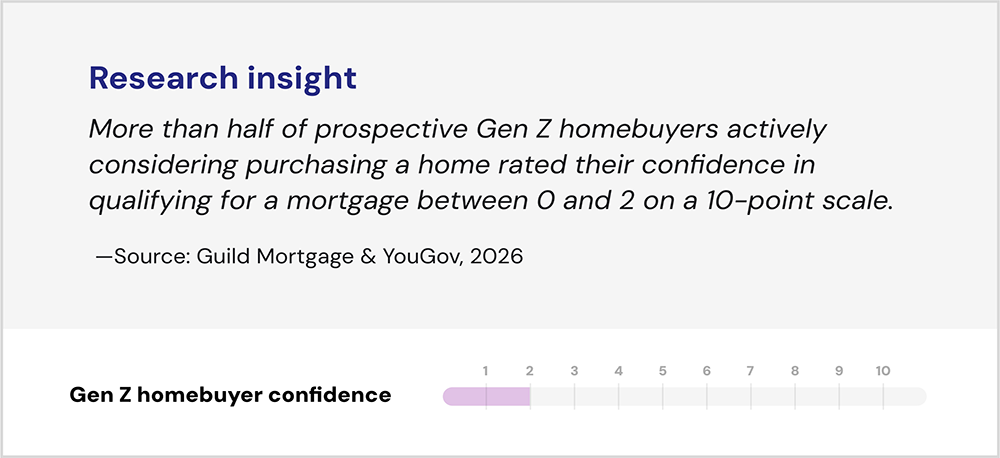
The Guild Mortgage and YouGov research highlights this disconnect. Although respondents expressed an interest in purchasing a home, many had already concluded they were unlikely to qualify. More than half of those actively considering homeownership rated their confidence in qualifying for a mortgage between 0 and 2 on a 10-point scale (Guild Mortgage & YouGov, 2026).
The research does not measure whether these individuals actually qualify for a mortgage. Instead, it measures whether they believe they do.
That distinction reveals an important gap between perceived readiness and actual readiness.
Understanding where you stand financially is important. Equally important is understanding that assumptions aren’t the same as facts. Before deciding you aren’t ready to buy a home, it’s worth asking whether that conclusion is based on accurate information or simply uncertainty about the process.
Many prospective buyers assume their income determines whether homeownership is possible.
The research tells a much different story.
Think you don’t make enough? The research says otherwise.
One of the biggest assumptions prospective homebuyers make is that their income alone determines whether they’re ready to buy a home.
It’s an understandable conclusion. Rising home prices and frequent headlines about affordability can make homeownership feel out of reach before someone has even explored the possibilities. As a result, many prospective buyers quietly decide they do not earn enough to qualify for a mortgage and postpone learning what options may actually be available to them.
The research suggests the relationship between income and confidence is far more complex.
Guild Mortgage and YouGov found that mortgage qualification confidence didn’t consistently increase alongside income. Among Gen Z respondents earning between $25,000 and $49,999 annually, the average confidence score was just 1.82 out of 10. Surprisingly, respondents earning less than $25,000 annually reported a slightly higher average confidence score of 2.17. Even respondents earning $150,000 or more averaged only 2.94 out of 10, still below the overall study average (Guild Mortgage & YouGov, 2026).
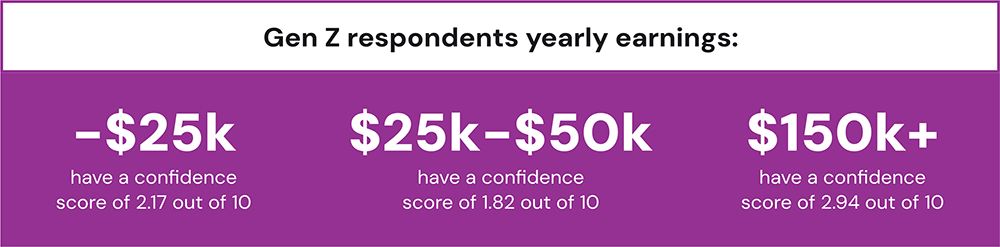
At first glance, these findings appear counterintuitive. Conventional wisdom suggests that higher income should naturally lead to greater confidence about qualifying for a mortgage. Instead, the data reveals that confidence is influenced by much more than income alone.
Perhaps the most revealing finding came from respondents earning between $25,000 and $49,999 annually. Nearly two-thirds of individuals within this income range rated their confidence between 0 and 2 on a 10-point scale, despite the fact that many borrowers within this income range may qualify for down payment assistance programs or other affordable lending solutions, depending on their individual circumstances and local program availability.
This finding reframes one of the most common assumptions about homeownership. Income certainly influences purchasing power, but it doesn’t tell the entire story. Many prospective buyers dismiss the possibility of homeownership without first understanding the mortgage programs, down payment assistance options or financing solutions that may be available to them.
Confidence does not always reflect qualification.
Every buyer’s financial situation is unique. Mortgage programs, down payment assistance, grants and qualification requirements vary based on factors such as income, credit history, available assets, property location and individual borrower circumstances. What may not be possible for one buyer could be well within reach for another.
Rather than asking whether a specific salary is enough to purchase a home, prospective buyers may benefit from asking a different question:
Have I explored all of the options available to me?
For many people, the answer is no.
That isn’t because they lack potential. It’s because they have never had the opportunity to understand what programs exist, how mortgage qualification works or what steps they could take to strengthen their financial position over time.
The research suggests that perceived readiness is often shaped just as much by information and confidence as it is by income itself.
Understanding what you earn is only one part of the equation.
Understanding what’s possible is equally important.
Sometimes the biggest barrier isn’t a buyer’s financial profile. It’s the belief that there’s no reason to ask the question in the first place.
Assumptions often become barriers before the process even begins.
That realization leads to another important question. If finances are only part of the equation, why do so many prospective buyers still feel they are not ready to begin?
Why so many buyers think they aren’t ready
For many prospective homebuyers, uncertainty has little to do with whether they can qualify for a mortgage. Instead, it stems from feeling unfamiliar with a process that can seem complicated, intimidating and filled with terminology they have never encountered before.
The Guild Mortgage and YouGov research provides important insight into this experience. When respondents were asked what would make homebuying feel more achievable, their answers focused less on financial barriers and more on understanding the process itself. One respondent shared a desire for someone to “break down the entire process for me, step-by-step, as simply as if I were a five-year-old.” Another explained that feeling embarrassed about not understanding the process created anxiety that discouraged them from asking for help (Guild Mortgage & YouGov, 2026).
These responses reveal something that numbers alone can’t capture. Many prospective buyers aren’t delaying homeownership because they have been told they can’t qualify. They are delaying because they don’t know where to begin.
The barrier is often not eligibility. It’s uncertainty.
That hesitation is understandable.
Buying a home involves learning about financing, budgeting, inspections, appraisals, homeowners insurance, closing costs and many other considerations, often for the very first time. Without trusted guidance, the process can feel overwhelming long before someone ever submits a mortgage application.
Many respondents described wanting someone to explain the process clearly and transparently rather than simply presenting them with loan options. They wanted to understand what to expect, what resources were available, and whether homeownership was realistic for someone in their situation. They weren’t asking to be sold a mortgage. They were asking for education that would help them make an informed decision.
One of the most encouraging findings from the research is that asking questions should never be viewed as a sign of being unprepared. In fact, it’s often one of the strongest indicators that someone is beginning to prepare responsibly.
Learning about the mortgage process before making any commitments allows prospective buyers to replace uncertainty with understanding. Knowing how mortgage financing works, what documents are typically required, what assistance programs may be available and how monthly housing costs are calculated can make the process feel significantly more manageable.
Even individuals who ultimately decide to wait before purchasing can benefit from understanding what steps will help strengthen their financial position over time. Knowing where you stand today provides a clearer roadmap for tomorrow.
The research also found that confidence generally increased with age and experience. Respondents between the ages of 26 and 29 reported higher confidence than those between the ages of 18 and 21, suggesting that confidence often grows as individuals gain greater exposure to personal finance, employment, and the homebuying process (Guild Mortgage & YouGov, 2026).
Knowledge doesn’t eliminate every challenge associated with purchasing a home.
Knowledge replaces uncertainty with confidence.
That distinction is important because readiness isn’t simply about reaching a particular financial milestone. It’s also about developing the understanding needed to make informed decisions.
For many prospective buyers, the first step isn’t completing a mortgage application.
The first step is feeling confident enough to ask the first question.
The questions you should ask yourself before buying
There’s no universal formula for determining whether someone is ready to buy a home. Every prospective buyer has different financial circumstances, career aspirations, family priorities and long-term goals. What feels like the right time for one person may not be the right time for another.
Rather than focusing on a single measure of readiness, prospective buyers may benefit from asking themselves a series of thoughtful questions. The answers may not determine whether someone should purchase a home today, but they can provide valuable insight into what steps come next.
Am I financially prepared for the responsibilities of homeownership?
This question extends beyond qualifying for a mortgage. It includes understanding how a monthly mortgage payment fits within an overall budget, planning for ongoing homeownership expenses such as maintenance and insurance, and evaluating whether current financial habits support long-term stability.
Do I expect to remain in this community for the foreseeable future?
Purchasing a home is often more than a financial decision. It’s also a lifestyle decision. While there is no required timeline for homeownership, individuals who anticipate relocating in the near future may have different considerations than those planning to establish long-term roots in their community.
Have I explored the mortgage programs and homebuyer resources available to me?
Many prospective buyers assume they already know what they qualify for before ever speaking with a mortgage professional. However, loan products, down payment assistance programs and local homebuyer initiatives continue to evolve. Exploring available options may reveal opportunities that prospective buyers didn’t realize existed.
Am I delaying because I am unprepared, or because I am uncertain?
This may be the most important question of all.
The Guild Mortgage and YouGov research suggests that uncertainty often becomes the deciding factor long before a prospective buyer fully understands what’s possible. Many respondents expressed genuine interest in homeownership while simultaneously lacking confidence in their ability to qualify for a mortgage. Their hesitation wasn’t necessarily rooted in financial limitations. More often, it reflected uncertainty about the process itself and a lack of confidence in knowing where to begin (Guild Mortgage & YouGov, 2026).
These questions are not intended to produce a simple yes-or-no answer. Instead, they provide a framework for evaluating readiness based on facts rather than assumptions.
For some prospective buyers, the answers may confirm they’re ready to begin exploring homeownership. For others, the answers may identify specific areas where additional preparation could strengthen their financial position and increase their confidence.
Either outcome represents progress.
Readiness isn’t measured by having every answer before taking the first step.
Readiness is measured by understanding where you stand today and knowing what steps will help you move forward.
That understanding begins with replacing uncertainty with informed guidance. For many prospective buyers, that’s the moment confidence begins to grow.
You may be closer than you think
So, am I ready to buy a home?
The answer is different for every prospective homebuyer. However, the research makes one thing clear: readiness isn’t determined by a single number, a perfect credit score or reaching a specific savings goal.
The Guild Mortgage and YouGov research demonstrates that many prospective buyers underestimate their readiness long before they understand what’s actually required to purchase a home. Too often, uncertainty becomes the deciding factor, preventing individuals from exploring opportunities that may already be within reach (Guild Mortgage & YouGov, 2026).
That finding has important implications, not only for prospective homebuyers but also for the broader housing industry. If buyers are ruling themselves out before ever speaking with a mortgage professional, then many opportunities to educate, encourage and guide future homeowners are being missed.
The greatest obstacle isn’t always financial readiness. It’s the confidence to begin the conversation.
The most important step isn’t having every answer before you begin. It’s being willing to ask questions, understand your options and evaluate your individual circumstances using accurate information rather than assumptions.
Whether you’re preparing to purchase your first home in the coming months or simply beginning to explore the possibility, taking the time to learn about the process can help you make informed decisions with greater confidence. Even if homeownership isn’t the right step today, understanding what it will take to get there can help you create a plan for the future.
The research suggests that confidence grows through education, trusted guidance and a clearer understanding of what’s possible. The more prospective buyers learn about the homebuying process, the better equipped they are to determine whether they’re ready today or what steps will help them become ready tomorrow.
Homeownership isn’t about having every detail figured out before asking the first question. It’s about taking the time to understand your options and making informed decisions with confidence.
If you have been asking yourself, “Am I ready to buy a home?”, consider starting with a conversation rather than an assumption. A Guild Mortgage loan officer can help you evaluate your financial situation, explain the mortgage options and homebuyer assistance programs that may be available to you, and answer your questions based on your unique goals and circumstances. Whether you’re ready to purchase today or planning for the future, the right guidance can help you better understand your options and determine the next steps on your path toward homeownership.
References
Guild Mortgage & YouGov. (2026). Gen Z Homebuyer Research Study.
Consumers may request additional information regarding the methodology or supporting data by contacting Guild Mortgage.